Contributing to Meshery UI - Notification Center
Prerequisite Reading
Table of Contents
- Table of Contents
- What is the Notification Center?
- Key Files and Directories
- Metadata Formatter
- How Notification Metadata is Rendered
- Types of Event Specific Notification Formatters
What is the Notification Center?
The Notification Center is a dedicated panel in Meshery’s UI that helps you monitor, understand, and respond to events across your system. It acts as a central place where you can see important updates related to your infrastructure, workloads, and Meshery’s internal operations.
Want to understand how users interact with the Notification Center? Learn more here.
The NotificationCenter component of Meshery UI receives events over a Server-Sent Events (SSE) stream and implements robust filtering on top of them. Events are persisted in Meshery Server and state management on the client is done using Redux Toolkit and RTK Query.
User-facing Features
- Robust filtering support inspired by GitHub’s notification filtering style.
- Search is also included.
- Proper hierarchical presentation of error details, including probable cause and suggested remediation.
- Support for notification status (notifications can be marked as read and unread)
- Future: Notifications can be acknowledged or resolved.
- Event-based notification via an SSE subscription (provided by Meshery Server and any upstream components or externally managed systems, like Kubernetes)
- Sharing of a notification to social platforms, and a direct link to the error code reference documentation when the event carries an error code.
- Infinite scroll for pagination.
How Events Reach the Client
Real-time delivery is handled by a native EventSource connection. This replaced the former GraphQL subscribeEvents subscription, so contributors should not expect to find Relay or GraphQL code in this path anymore.
The chain looks like this:
NotificationCenterProvider(index.tsx) spawns theoperationsCenterActorstate machine usinguseActorRef.- The machine spawns a subscription actor that calls
subscribeToEventsfromui/lib/eventsSubscription.ts. subscribeToEventsopens anEventSourceagainstGET /api/system/events/subscribe. Because the stream is same-origin, the browser automatically carries themeshery-providerauth cookie.- Each frame arrives as
data: <event-json>and is parsed into the raw event object. This is the same camelCase shape that the REST endpoint/api/system/eventsreturns, so it is consumed as-is by the rest of the UI. - For every event received, the machine stores it in Redux (
pushEvent, which upserts by ID, so a condition’s event the server broadcasts again after counting an occurrence or resolving it updates in place), invalidates the relevant RTK Query cache tag, and raises a toast throughnotify.
Connection failures are handled inside subscribeToEvents. EventSource reconnects on its own while the connection is merely dropping, so an error is only surfaced to the caller once the browser permanently closes the stream. That notification is additionally delayed by a few seconds, which prevents a persistent failure (an expired session, for example) from turning caller-driven re-subscription into a request storm. The function returns a { dispose } handle, and the state machine restarts the subscription actor when an error is finally reported.
All other operations — listing, filtering, marking read/unread, deleting, and configuration — go through REST endpoints under /api/system/events defined in ui/rtk-query/notificationCenter.ts.
State Management and Internal Details
- The state on the client is managed using
Redux ToolkitandRTK Query. - Update and Delete operations are optimistically handled.
- Network requests are cached and invalidated when new events arrive or events are deleted/updated.
- Due to the need for infinite scroll and optimistic updates, events are stored globally in Redux (
ui/store/slices/events.ts) using an entity adapter.
Bulk Operations
Bulk operations in the Notification Center allow users to perform actions like deleting multiple notifications or changing the status of multiple notifications in a batch. This documentation outlines the key features and functionality of bulk operations, including the restriction of performing only one bulk operation at a time, the disabling of buttons during ongoing operations, and the display of a loading icon to indicate ongoing activity.
Initiating a Bulk Operation
- Users select the notifications they want to include in the bulk operation. This is typically done by checking checkboxes next to each notification.
- After selecting notifications, users trigger the desired bulk operation (e.g., delete or change status) by clicking the corresponding action button.
- Once initiated, the bulk operation begins processing the selected notifications.
Key Files and Directories
This section outlines the essential files and folders that you’ll interact with when working on the Notification Center. Every file in this directory has a colocated *.test.tsx file; add or update tests alongside any change you make.
NotificationCenter/ (Root Directory)
Path: ui/components/layout/NotificationCenter/
- index.tsx: Contains the main context provider (
NotificationCenterProvider), the drawer component, the severity chips, the bulk action bar, and the event list. It also spawns theoperationsCenterActorthat owns the SSE subscription. - metadata.tsx: Defines
PropertyFormatters,LinkFormatters,PropertyLinkFormatters, and the internalEventTypeFormattersregistry. Contains theFormattedMetadatacomponent which decides how to format the metadata based on event type or specific properties, plusFormattedLinkMetadatafor the links rendered in the header of an expanded notification. - notification.tsx: Defines how an individual notification is rendered, including the summary row, the ellipsis menu (
Share,Error Docs, metadata links, delete, change status), and the expanded detail view. Also exportsgetErrorCodesFromEventandcanTruncateDescription. - constants.tsx: Defines
SEVERITY,STATUS,SEVERITY_STYLE, theEVENT_TYPEcatalog, and theeventDetailFormatterKeyhelper used to key event specific formatters. - filter.tsx: Builds the filter schema (severity, status, action, author, category) consumed by the shared typing-filter field. The available actions and categories are fetched from
/api/system/events/types. - notificationCenter.style.tsx and shared.style.tsx: Styled components for the drawer, list, chips, and menus.
formatters/ (NotificationCenter/formatters)
This directory houses reusable formatter components dedicated to specific types of metadata or event types.
- common.tsx: Contains shared components like
TitleLink,DataToFileLink, andEmptyState. - error.tsx: Defines
ErrorMetadataFormatterfor displaying structured error details. - event_error.ts: The single reader of
metadata.error.normalizeEventErrorreads the schemasEventError(nested causes,matchedCauses,referenceUrl), the legacy MeshKit error stored with Go field names, and a design event’s{code, message}into one view model;eventErrorCodeandeventErrorReferenceUrlread the code and reference page of either shape. Never indexmetadata.errorkeys directly in a formatter. - condition.tsx:
getEventConditionreads an event’s condition fields (correlationKey,occurrenceCount,firstSeenAt,lastSeenAt,resolvedAt);ConditionBadgesrenders the summary row’s occurrence count and “Resolved” badge, andConditionSummarythe detail panel’s condition line. An event without these fields renders as before. - model_registration.tsx: Contains formatters for model import/registration events (
ModelImportMessages,ModelImportedSection). - pattern_dryrun.tsx: Defines
DryRunResponseandSchemaValidationFormatter, which delegate to the design lifecycle components. - design_event_metadata.ts: The single reader of design event metadata.
getDesignEventIdentityreturnsdesignId,designName,designVersion,designLinkandviewLink, falling back to the legacydesign_id,design_nameandview_linkonly when the camelCase key is absent;getDesignEventErrorSummaryreadsstatus,errorCount,errors[]andtruncated;isMeshkitErrorCodetells a MeshKit code (meshery-server-1480) from a JSON-schema keyword or Kubernetes cause type. Never index these metadata keys directly in a formatter. - design_event_errors.tsx: Defines
DesignEventErrorsFormatter, which renders an error summary for validate, deploy, undeploy and dry-run events and links only MeshKit codes to the error code reference. - relationship_evaluation.tsx: Defines
RelationshipEvaluationEventFormatter, responsible for rendering notifications related to the evaluation of relationships between components in a design. - meshsync_events.tsx: Defines
MeshSyncPropertyFormattersfor connection and MeshSync deployment fields. - academy_events.tsx: Defines
AcademyEventsFormatterfor quiz evaluation results. - RegistrantSummaryFormatter.tsx: Formatter for registrant summary events. Currently present but not registered in
metadata.tsx.
Components Outside the Directory
Two dependencies live outside the Notification Center but are worth knowing about:
ui/components/data-formatter/provides the generic structured-data renderer (FormatStructuredData) that the Notification Center uses as its fallback, along with the primitives formatters compose with (SectionBody,KeyValue,ArrayFormatter,TextWithLinks,TitleLinkhelpers,reorderObjectProperties). Changes there affect other parts of Meshery UI, so treat it as a shared library rather than Notification Center code.ui/components/designs/lifecycle/providesDeploymentSummaryFormatter,FormatDryRunResponse, andValidationResults, which are reused by design-related notifications.
Metadata Formatter
When the server sends an event, it follows a consistent schema that contains metadata intended for user presentation. This metadata typically includes fields such as description, createdAt, userID, systemID, action, category, and the resources involved.
In some cases, the metadata may also contain more detailed information—such as a traceback, a summary, or a complete error log—which is dynamically generated at runtime and encapsulated within the event.
Presenting this structured information in a clear and accessible way is essential, as it provides valuable insights into system behavior and ongoing operations.
To accomplish this task, we employ metadata formatters that transform structured data into visually appealing formats. There are currently two types of formatters in use:
- Metadata Specific Formatters: These formatters are specifically designed for particular types of metadata, such as errors and dry run responses. Metadata Specific Formatters are implemented as React components that take the metadata as input and render it within the component.
- Dynamic Formatter: Since metadata can vary significantly in structure, it is not practical to create a specific formatter for each kind. The dynamic formatter analyzes the schema’s structure and applies custom-defined rules for formatting.
The Dynamic Formatter
The dynamic formatter is FormatStructuredData, imported from ui/components/data-formatter. It walks the metadata recursively and picks a renderer based on the shape of each value:
- Text strings are rendered with
SectionBody, which usesTextWithLinksto detect URLs in the string and replace them with link components. - Arrays are rendered with
ArrayFormatteras a bulletized list, recursing into each item. - Object properties with string values are treated as key-value pairs and rendered with
KeyValue. - Nested objects get a section heading and are rendered recursively, with the heading size decreasing by depth.
FormatStructuredData accepts a propertyFormatters map. Whenever a property name matches a key in that map, the mapped function takes over rendering for that property, which is how the Notification Center injects its own formatters into an otherwise generic renderer.
The Metadata Specific Formatter
Certain metadata, such as Design deployment summaries and Errors, hold high importance and have dedicated renderers. These dedicated renderers can still utilize the dynamic formatter to format specific parts of the response.
Reusability
While this system was initially developed for our events and notification center, the components it comprises are highly reusable and can be employed in other contexts where dynamic formatting of structured data is required.
How Notification Metadata is Rendered
When a notification event is received from the server, it includes a metadata field containing structured, event-specific information. The purpose of formatters is to present this data in a clean, readable, and user-friendly format inside the expanded view of each notification.
The core logic for rendering metadata is handled by the FormattedMetadata component in metadata.tsx, which follows this decision tree:
Event-Specific Formatter Check If a formatter is registered for the event’s
actionandcategorycombination (underEventTypeFormatters), that dedicated formatter is used and receives the wholeevent, giving it full control over how the metadata is displayed.Empty Metadata Check If the event has no metadata, or the metadata is empty at all depths,
EmptyStaterenders the event description on its own.Fallback to Property-Based Formatting Otherwise,
FormattedMetadatareorders the metadata into a stable display order, strips out properties that are rendered elsewhere (links,id,kind, and - when a design-saved event’sdesign{id, name} link names the design - the design identity keys), and hands the result toFormatStructuredDataalong with:PropertyFormatters– for structured or specialized visual formats.PropertyLinkFormatters– consumed separately by the ellipsis menu innotification.tsxto render actionable links (e.g. file downloads, log views).
Registering an Event Specific Formatter
Formatters are keyed by eventDetailFormatterKey, which produces a string in the form `${action}-${category}`. To add a new one:
- Add an entry to
EVENT_TYPEinconstants.tsxwith the event’sactionandcategory, matching what Meshery Server emits. - Create the formatter component under
formatters/. It receives a singleeventprop. - Register it in the
EventTypeFormattersmap inmetadata.tsxusingeventDetailFormatterKey(EVENT_TYPE.YOUR_EVENT).
Types of Event Specific Notification Formatters
Common Formatter
Path: ui/components/layout/NotificationCenter/formatters/common.tsx
The following reusable components standardize how notification links, empty states, and downloadable traces are displayed:
TitleLink: Renders a styled title with an external link icon. Any additional anchor attributes are forwarded, so
target="_self"can be used for in-app navigation. Props:href(required): URL of the link.children: The link text.
EmptyState: Displays the event description when no specific metadata is available for an event. Props:
event(required): The event object; onlydescriptionis read.
DataToFileLink: Converts event data into a downloadable
.txtfile. Props:data(required): Can be a string or a JSON-serializable object.
Error Formatter
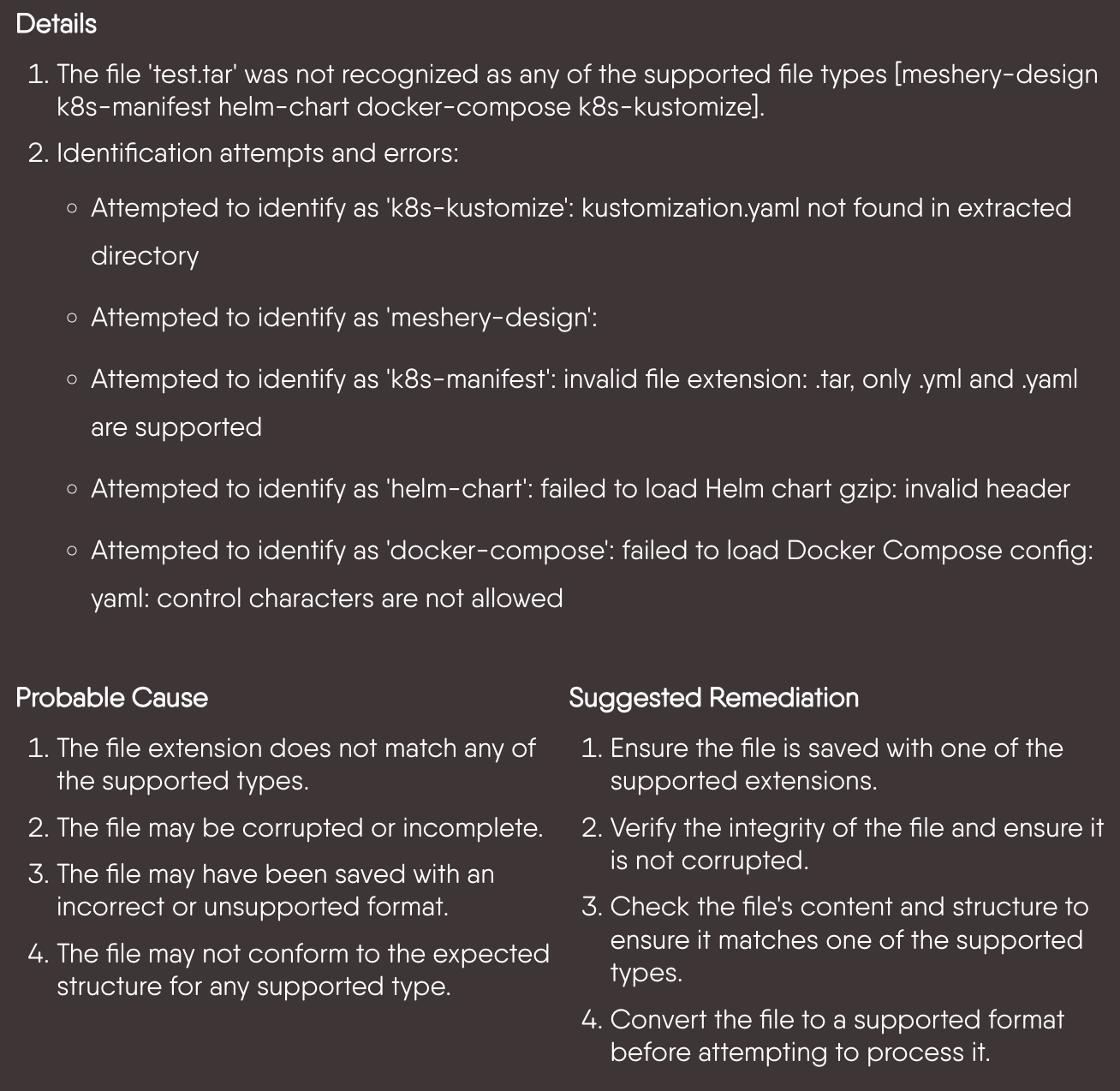
The ErrorMetadataFormatter renders an error event’s metadata.error. It reads every shape the field is stored in through normalizeEventError (formatters/event_error.ts):
- Details: the long description rendered for this occurrence.
- Probable Causes, when the producer paired each cause with its remediations (a schemas
EventErrorwithprobableCauses, from a MeshKiterrors.NewV3error): one card per cause, listing the remediations that address it. The causes named inmatchedCausescome first, marked “Likely cause” (with the producer’s confidence when it gave one). A remediation whoseactionPolicyisautomaticorrequiresApprovalcarries a label saying so; the Notification Center runs no action. A remediation shared by several causes is listed under each. - Probable Cause and Suggested Remediation, for an unpaired error: MeshKit’s flat lists, including every row recorded before the pairing existed (Go field names
LongDescription,ProbableCause,SuggestedRemediation). The two lists are never paired by position. - A link to the code’s reference page when
metadata.error.referenceUrlis set.
Each entry is rendered as Markdown. The event’s full description is shown above the details only when the summary row had to truncate it. Inside the ellipsis menu, Error Docs opens the code’s referenceUrl, else the code’s anchor on the error code reference; getErrorCodesFromEvent reads the code from metadata.error (code or legacy Code), design event errors and metadata.ModelDetails.
Props:
metadata(unknown): the event’smetadata.error, in any shape.event(object, optional): the notification event. Onlydescriptionis read.FormattedMetadatapasses the notification’s event.
Path: ui/components/layout/NotificationCenter/formatters/error.tsx
Example:
<ErrorMetadataFormatter
  metadata={{
    code: 'meshery-server-1304',
    longDescription: 'dial tcp 10.0.0.1:6443: connect: connection refused',
    probableCauses: [
      {
        id: 'api-server-unreachable',
        description: 'The Kubernetes API server is not reachable.',
        remediations: [{ id: 'check-network', description: 'Verify network connectivity.' }],
      },
    ],
    matchedCauses: [{ causeId: 'api-server-unreachable' }],
  }}
  event={{ description: 'Could not assign server id, skipping context prod' }}
/>
When to Use:
The ErrorMetadataFormatter is used for every metadata.error. A new formatter should be created only if an event’s error metadata deviates from the schemas EventError and the legacy MeshKit shape.
Conditions
An event that reports an ongoing condition counts its repeats instead of recording a notification each (server events). When its occurrenceCount is above one, the summary row shows the count and the time it was last seen; a resolved condition shows a “Resolved” badge. The expanded notification lists how often it occurred, when it was first and last seen, and when it was resolved.
Model Registration Formatter
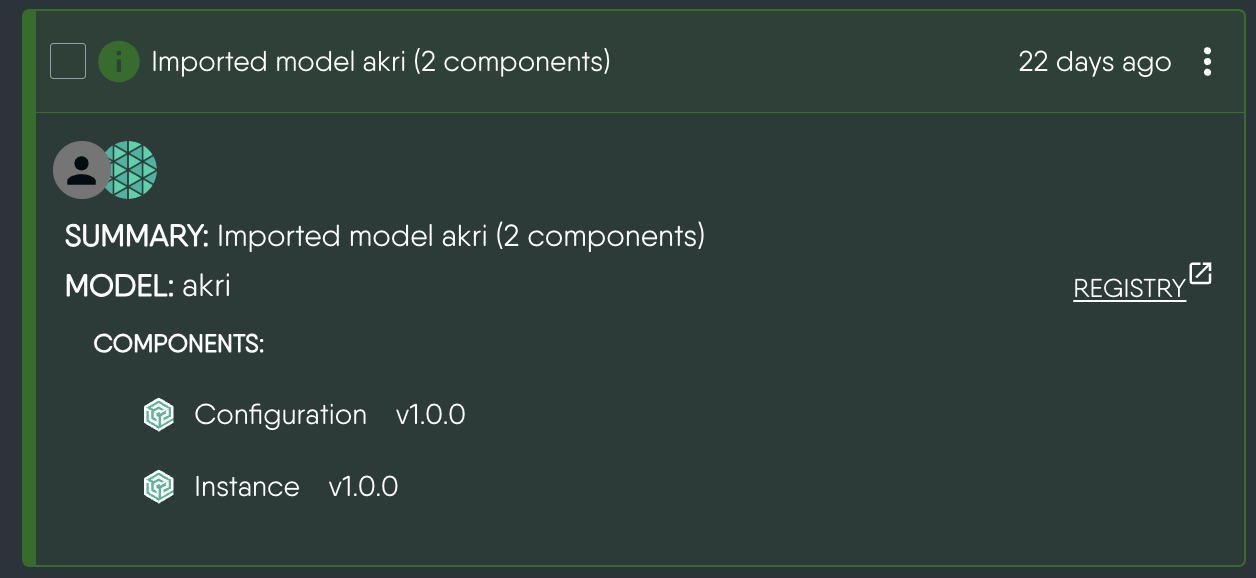
The Model Registration Formatter formats and displays model registration details, including components and relationships, in Meshery UI’s Notification Center. It ensures structured representation of imported models and error handling during the import process. It also distinguishes between models and standalone entity files (.yaml, .yml, .json), labelling the heading accordingly and linking successful model imports to the registry.
Path: ui/components/layout/NotificationCenter/formatters/model_registration.tsx
Components:
ModelImportedSection (exported): Displays the details of the imported model along with components, relationships, and any errors that occur.
Props:
modelDetails(object): A map of model name to import details, each containing optionalComponents,Relationships, andErrorsarrays.
ModelImportMessages (exported): Renders the import summary line.
Props:
message(node): The summary message supplied by the server.
UnsuccessfulEntityWithError (internal): Used by
ModelImportedSectionto handle error cases during model import. It identifies the type and count of entities that failed to import and delegates the error body toErrorMetadataFormatter.Props:
modelName(string): The name of the model or file being imported.error(object): Containsname,entityType, and the nestederrordetails.
Relationship Evaluation Formatter
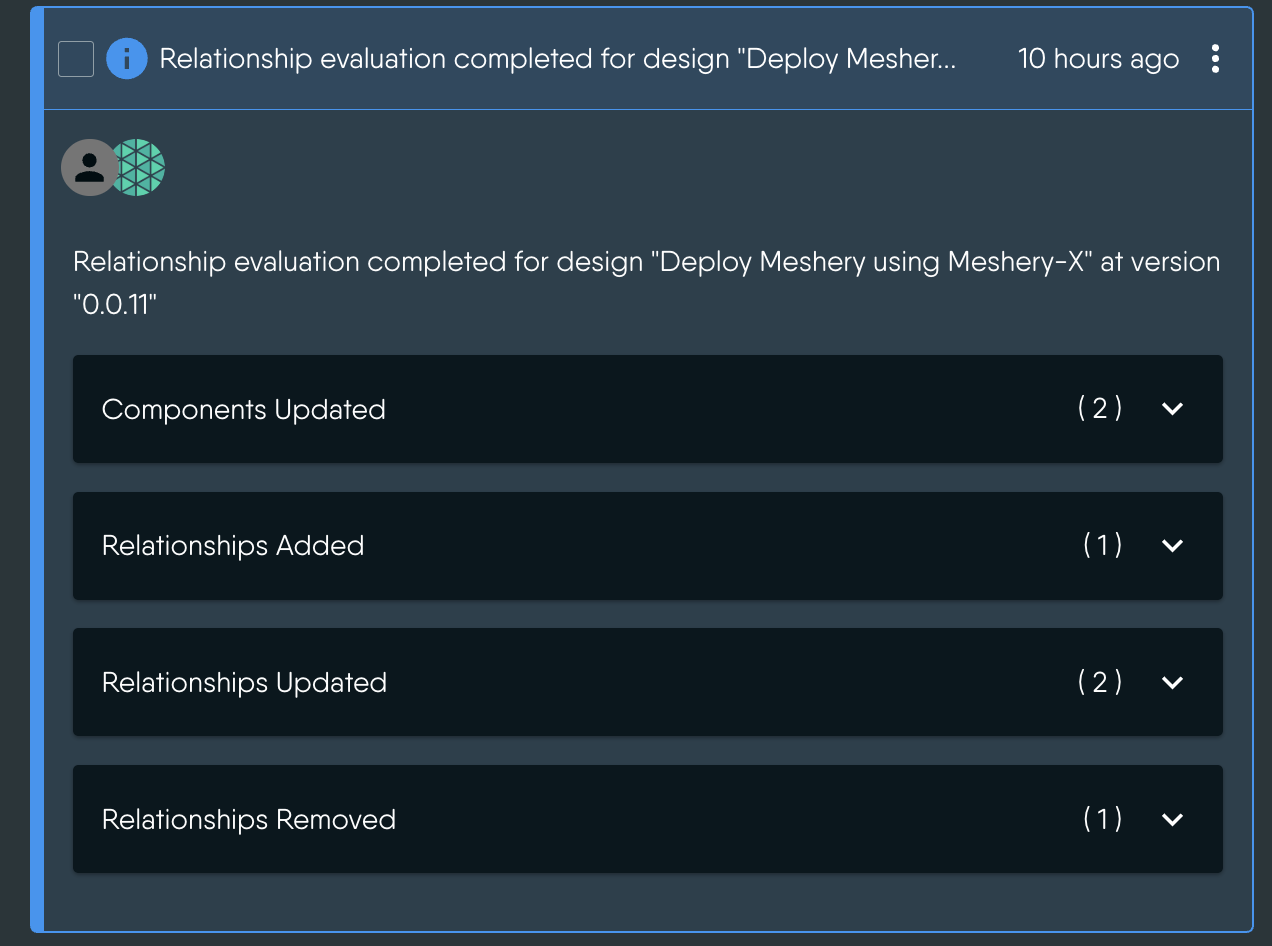
The Relationship Evaluation Formatter is responsible for rendering notifications related to the evaluation of relationships between components in a design. It provides a detailed breakdown of changes in components and relationships, such as additions, updates, and removals, during the evaluation process.
Path: ui/components/layout/NotificationCenter/formatters/relationship_evaluation.tsx
Key Components
- RelationshipEvaluationEventFormatter:
The main formatter component. It renders the event description and the evaluation summary: the relationship change counts,
evaluationStatus,evaluationDurationMsand an “Open design” link fromdesignLink, the designer URL (falling back toviewLinkon older rows). Each of the last three is rendered only when present - rows Meshery Cloud rewrote to this shape lack them. Only an event without the summary fields falls back toRelationshipEvaluationTraceFormatter.
Props:
event(object): Contains:- description: A description of the evaluation process.
- metadata:
relationshipsAdded,relationshipsRemoved,relationshipsUpdated,evaluationStatus,evaluationDurationMs,historyTitle,evaluatedAtand the design identity. Events stored before #22764 instead carryevaluationResponse(orevaluation_response) with theactionsand the evaluateddesign.
RelationshipEvaluationTraceFormatter: Renders a legacy
evaluationResponse. Takesactionsanddesignand derives the displayed categories by filtering actions on theiropfield:- Components:
add_component,delete_component,update_component/update_component_configuration - Relationships:
add_relationship,delete_relationship,update_relationship
Each category is rendered as a collapsible section that shows its item count and is hidden entirely when empty. Deletions read the component or relationship from the action payload itself, while additions and updates are resolved against the design.
- Components:
When to Use
The Relationship Evaluation Formatter is specifically designed to handle notifications related to changes in components and their relationships during an evaluation process. Use this formatter in the following scenarios:
- When a notification involves the evaluation of relationships between components in a design.
- When you need to display categorized changes in components and relationships.
- When the event is a
relationship/evaluationevent; the formatter handles both the summary and the legacyevaluationResponseshape.
User Experience: Relationship Evaluation Notification
Evaluation Summary: The notification starts with a summary of the evaluation process. Example:
"Relationship evaluation complete: 3 changes in 'Deploy Meshery using Meshery-X' at version '0.0.11'"This gives the user context about which design and version were evaluated.Change Counts: The number of relationships added, removed and updated, followed by the evaluation status, its duration and an “Open design” link, each only when present. If no relationship changed, an empty state is shown instead.
The remaining items apply only to a legacy event stored before #22764, rendered by RelationshipEvaluationTraceFormatter:
Detailed Changes: The notification breaks down the changes into collapsible categories:
- Components:
- Added: New components introduced in the design.
- Updated: Existing components that were modified.
- Deleted: Components that were removed from the design.
- Relationships:
- Added: New relationships established between components.
- Updated: Existing relationships that were modified.
- Deleted: Relationships that were removed.
If the evaluation produced no actions at all, an empty state is shown instead.
- Components:
Component Details: For each component, the notification displays its icon, kind, name, and the model and version it belongs to.
Relationship Details: For each relationship, the notification displays its type, the source and target components involved, and the associated model and version.
Dry Run and Schema Validation Formatters
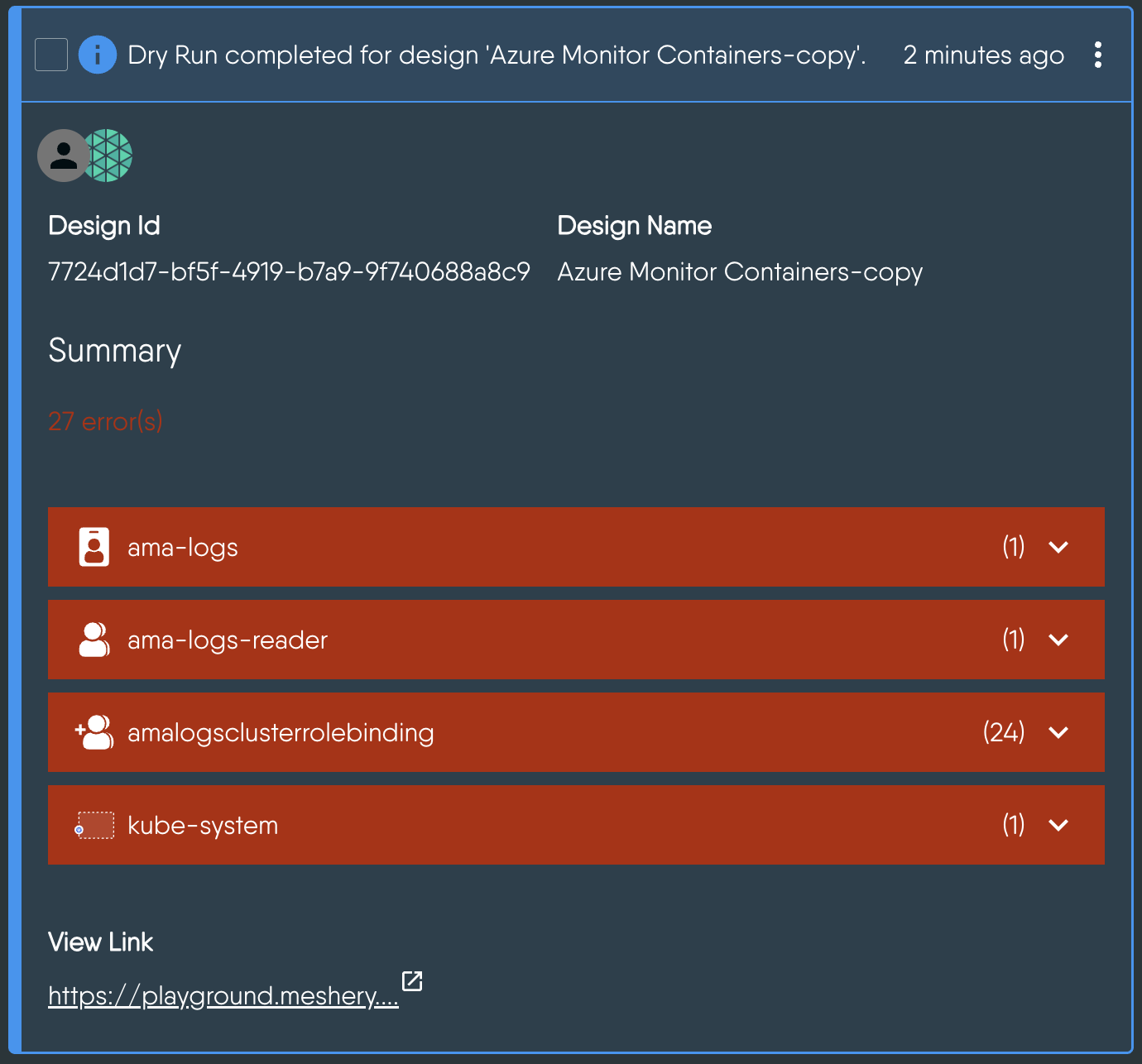
The Dry Run Formatter is responsible for rendering notifications related to the dry run validation of a design. A dry run simulates the deployment or undeployment of a design to identify potential errors without actually applying the changes.
Paths:
ui/components/layout/NotificationCenter/formatters/pattern_dryrun.tsx(Notification Center entry points)ui/components/designs/lifecycle/DryRun.tsxandui/components/designs/lifecycle/ValidateDesign.tsx(rendering)
Key Components
DryRunResponse: The property formatter registered for the
dryRunResponsemetadata field, also used byDeploymentSummaryFormatterfor a legacy dry-run event’ssummary.dryRunResponse. It normalizes the raw response and hands it toFormatDryRunResponse. Apattern/dry-runevent in the current shape is rendered by the Deployment Summary Formatter.Props:
response: The raw dry run response from the server.
FormatDryRunResponse: Renders the dry run validation results, including the total number of errors.
Props:
- dryRunErrors (array): An array of errors detected during the dry run. Each error includes:
type: The type of error (e.g.,RequestError,ComponentError).fieldPath: The specific field in the design where the error occurred.message: A detailed error message.
- configurableComponentsCount (number): The number of configurable components in the design.
- annotationComponentsCount (number): The number of annotation components in the design.
- validationMachine (object): The state machine handling the dry run validation process.
- currentComponentName (string): The name of the component currently being validated.
- dryRunErrors (array): An array of errors detected during the dry run. Each error includes:
SchemaValidationFormatter: The event specific formatter registered for
pattern/validateevents. It renders the design name and, throughDesignEventErrorsFormatter,status,errorCount,errors[]of{code, componentId}andtruncated. An error’scodeis the JSON-schema validator keyword (required,type, …) and is shown as-is. Only an event without that summary that still holds a legacyvalidationResultis rendered throughValidationResults, withtotalComponents,configurableComponentsandtotalErrors, falling back to the snake_casetotal_components,configurable_componentsandtotal_errors, and fortotalErrorsfinally to counting thevalidationResulterrors.Props:
event(object): The notification event.
When to Use
These formatters are used in the following scenarios:
- When a notification involves the validation of a design through a dry run process.
- When you need to display errors detected during the dry run.
- When the event metadata includes details about configurable and annotation components.
Deployment Summary Formatter
The Deployment Summary Formatter is responsible for rendering notifications related to the deployment or undeployment of components in a design.
Path: ui/components/designs/lifecycle/DeploymentSummary.tsx
Key Components
- DeploymentSummaryFormatter:
This component is used to display:
- Event Description: A brief description of the deployment event.
- Errors: The MeshKit
errorof a failed event, rendered throughErrorMetadataFormatter. - Error Summary:
status,errorCount,errors[]andtruncated, rendered throughDesignEventErrorsFormatter. A rewritten deploy error may carry acodebut nocomponentId. - Component Details: For an event stored before #22764 without an error summary, the components flattened out of the legacy per-context
summary, or itsdryRunResponse. - Open In Operator: A shortcut to the deployed design, shown only when the Meshery Operator is enabled and the action is neither a registration nor a dry-run - a dry-run deploys nothing to view.
Props:
- event (object): Contains:
- description: A brief description of the deployment event.
- action: The type of action performed (
deploy,undeployordry-run). - severity: The severity level of the event, used to colour the summary.
- metadata:
- status, errorCount, errors, truncated: The outcome and up to 20
{code, componentId}errors. - error: The MeshKit error of a failed event.
- designName and designId (legacy
design_nameanddesign_id): The design opened by Open In Operator, read throughgetDesignEventIdentity. - summary: Legacy only - the raw process response of an event stored before #22764.
- status, errorCount, errors, truncated: The outcome and up to 20
When to Use
The Deployment Summary Formatter should be used in the following scenarios:
- Deployment, Undeployment or Dry-Run Events:
It is registered for
pattern/deploy,pattern/undeployandpattern/dry-run. - When a notification involves the deployment or undeployment of a design.
MeshSync Events Formatter
Path: ui/components/layout/NotificationCenter/formatters/meshsync_events.tsx
This module exports MeshSyncPropertyFormatters, a set of property formatters that are spread into PropertyFormatters in metadata.tsx rather than registered as an event specific formatter. It covers connectionID, k8sContextID, k8sContextName, meshsyncDeploymentMode, operatorStatus, and brokerEndpoint.
Connection-related fields are rendered as clickable chips that deep-link into the connections page with the value pre-filled as a search term. Field names are humanized by humanizeFieldName, which converts camelCase keys into title case (for example, k8sContextName becomes K8s Context Name).
Academy Events Formatter
Path: ui/components/layout/NotificationCenter/formatters/academy_events.tsx
AcademyEventsFormatter renders quiz evaluation results from metadata.result, showing the quiz title, attempt time, score against the pass percentage, pass/fail outcome, and a per-question breakdown. It renders an inline message rather than throwing when the event payload is incomplete, which is a useful pattern to follow for formatters that depend on deeply nested metadata.
PropertyFormatters and PropertyLinkFormatters
Purpose:
When an event does not match an entry in EventTypeFormatters, PropertyFormatters are used to format and render specific metadata fields in a structured and visually appealing way. PropertyLinkFormatters are handled separately: notification.tsx maps the event metadata through them to build the actionable links shown in the ellipsis menu.
Examples of Property Formatters
- trace: Converts large trace data into a downloadable file link.
- ShortDescription: Displays a short description of the event, unless the event carries an error or the description is short enough to be shown in full in the summary row.
- error: Uses the
ErrorMetadataFormatterto display structured error details. - design: Renders a link that opens the saved design.
- dryRunResponse, ModelImportMessage, ModelDetails: Delegate to the dry run and model registration formatters.
- MeshSync fields: Spread in from
MeshSyncPropertyFormatters.
Examples of property link formatters include doc (documentation reference), DownloadLink (downloads a file through /api/system/fileDownload), and ViewLink (opens logs through /api/system/fileView).
When to Use
Use PropertyFormatters and PropertyLinkFormatters in the following scenarios:
- When an event does not have a specific
EventTypeFormatterdefined. - When you need to render individual metadata fields in a structured and visually appealing way.
- When the same field appears across several event types and should always look the same.
- When metadata includes fields like trace data, short descriptions, or error details that require specialized formatting.